
Interview with Alicja Szalska: The Art of Kites
Dear Alicja, you are a recognized artist within the kite community. Spiderkites is delighted to produce your designs, and It is a matter close to my heart to have this interview with you. When did you first come into contact with kites, and what sparked your interest in creating and building your own designs?
I grew up in a kite factory. When I was seven years old, my parents began collaborating with Michael Steltzer from Berlin and founded the first factory for modern kites in Poland. My parents have since retired and their factory no longer exists, but my brother and I continue the family tradition, albeit in a slightly different form.
Since I began living independently, I have always kept a few of my father’s kites with me, flying them occasionally. The year 2015 proved to be a breakthrough. In August, during the 5th International Kite Festival in Łeba, Poland, I reconnected with the kite world in which I had been raised. The following years were filled with intensive work organising the festival in Łeba and travelling to other international events. During festivals at that time, I flew kites made by my father and brother, which sparked a desire to create my own.
In 2017, I took part in a week-long workshop with my greatest mentor—my father, Wenancjusz Szalski. It was then that I sat down at a sewing machine for the first time in my life, and it immediately became clear that I could sew. It is incredible how a child’s brain absorbs its surroundings. Since then, I have been constantly engaged in the process of designing and building kites.
How important are family and friends in ensuring you feel comfortable in the world of kites?
If I were to create a hierarchical list of what I value most in the kite world, relationships would come first. I meet people who love kites as much as I do in various corners of the globe, and with each meeting, our bonds grow stronger. There are several kite enthusiasts whom I can honestly call friends. My closest family—my partner, parents, brother, and sister-in-law—are also all devoted to kites to some extent.
What inspires you to create new kites, and what is your process? Is it primarily the design and colours, or do the shape of the sail and tail have the greatest influence?
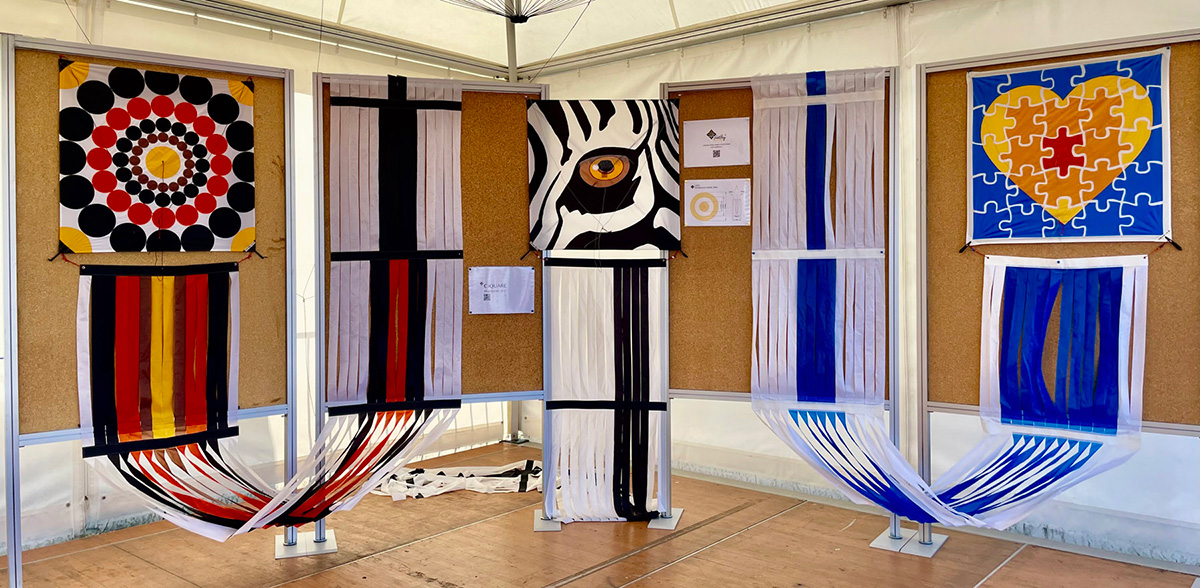
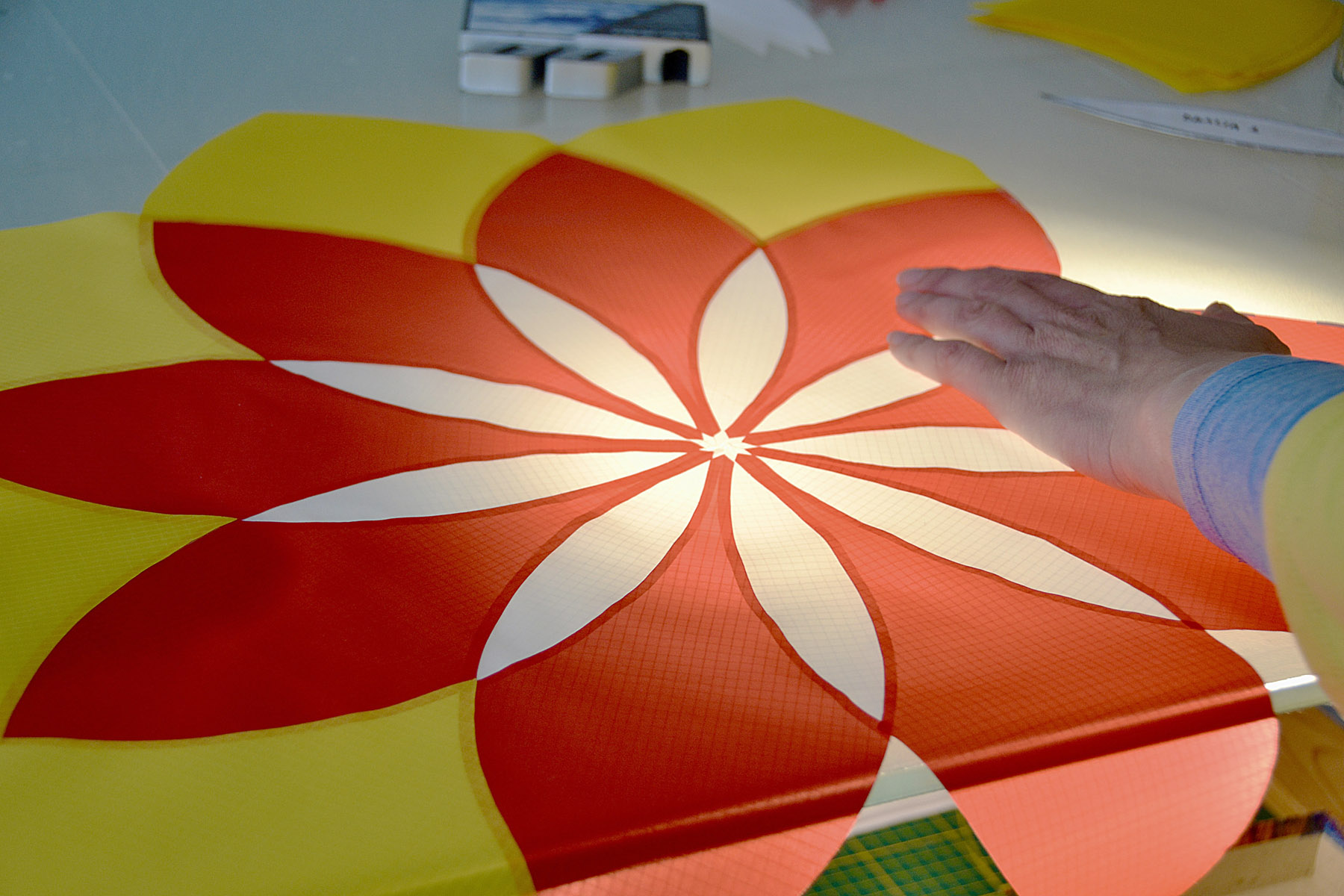
It depends. There are different reasons why I start a new project, and therefore different sources of inspiration. Usually, I choose simple shapes for flat or bowed kites and fill them with forms and colours. I often use the appliqué technique, but not always. Sometimes I combine different elements, and at other times I use painted fabrics.
I love birds, so I have created several kites with avian motifs. Every year, I also design a kite for an auction as part of Poland’s largest annual charity event; in this case, the inspiration comes from the graphic identity of that specific campaign.
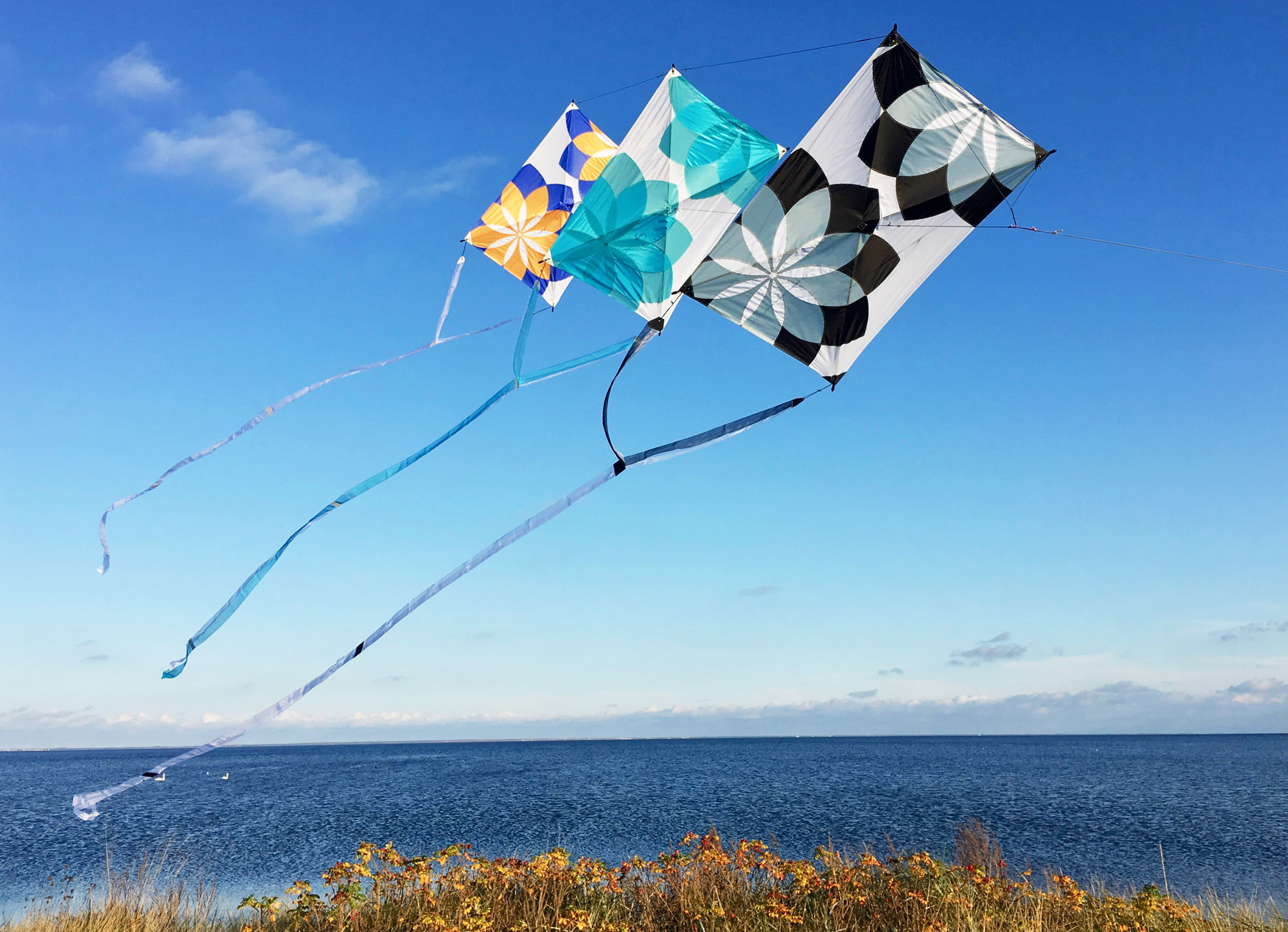
Sometimes I sit down with my laptop and experiment with shapes and colours in a graphic design programme—that is exactly how the Lotus Hexagon kite was created. Three years ago, I acquired a beautiful fabric painted with irregular patterns by Michel Gressier. I designed an Eddy kite around a central element made of this fabric, with the rest of the pattern complementing it. Inspired by Michel’s work, I also experimented last year with painting kite fabric myself using spray paint. These experiments led me to design a vented hexagon kite that performs well in strong winds.
Occasionally, I receive requests for personalised kites, in which case I design graphics related to the recipient. And that is how it goes—moving from one project to the next.
Is there a particular project you are currently working on?
I am usually working on several projects simultaneously, each at a different stage of development. One is already being sewn, another is at the stage of a finished template, and another still exists only in digital form.
Currently, I am working on a set of several Eddy kite trains using my spray-painted fabric. These are kites that I can produce relatively quickly, and they create a striking visual impact in the sky. This time, the inspiration comes partly from a lack of time and a desire to refresh my own collection of kites that I take to festivals.
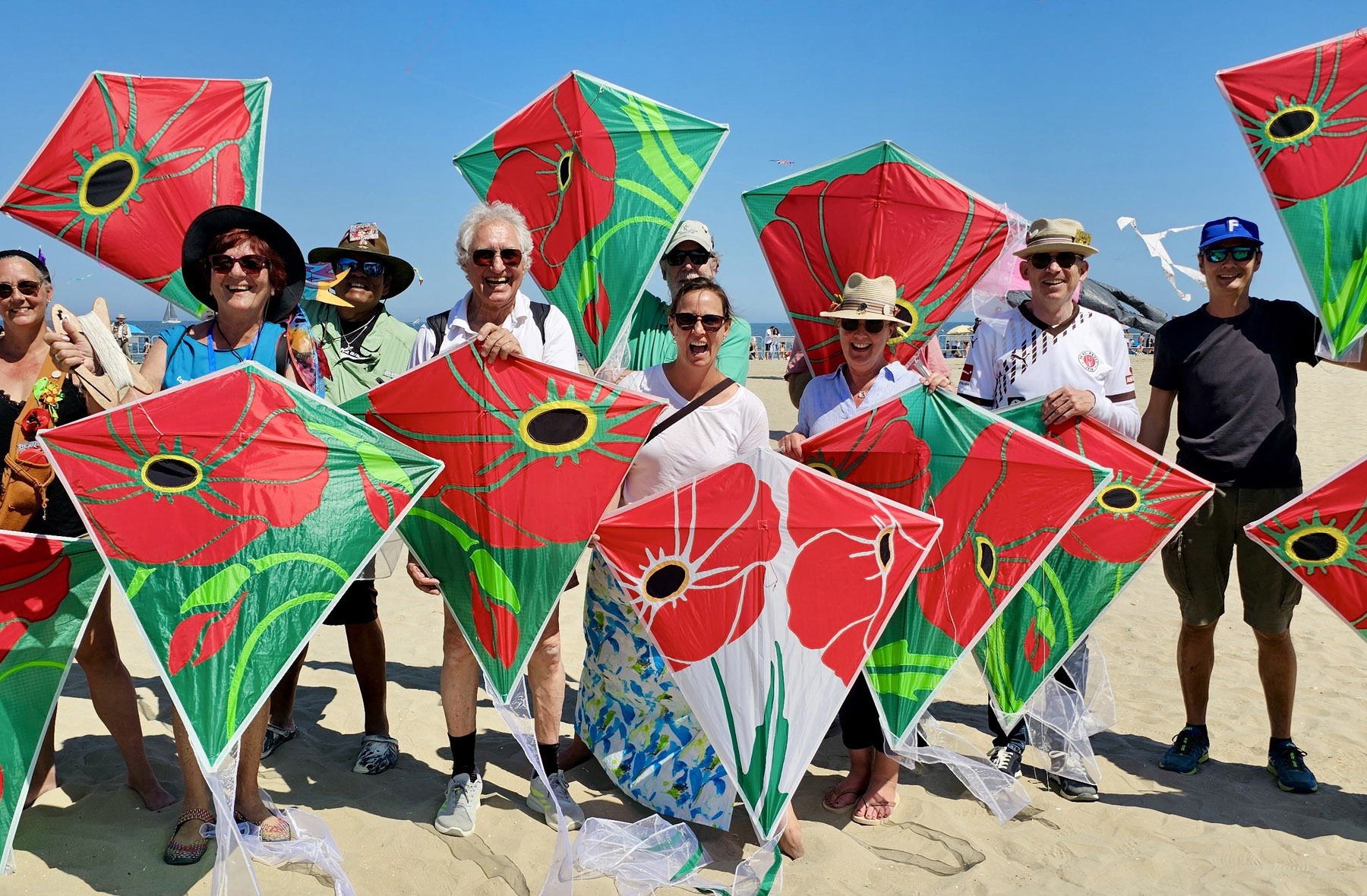
At the same time, I have two client projects in progress. One is a set of kites with a dahlia motif—a train of six Della Porta kites. The other is a set of five Eddy kites with a poppy motif. It seems that I am currently in a "flower phase"!
I am also working on two workshop projects. One will take place during the festival in Cervia, Italy, and the other as part of the festival in St Annes in the UK. I have already finalised the ideas and graphic designs and am slowly moving into the kit production stage.
You’ve already organised your own kite festival with great success. What does it mean to you to share the sky with other kitemakers and fly your kites at festivals all around the globe?
A small clarification: I have collaborated on organising several festivals (Łeba in Poland, Potsdam in Germany, and my brother’s festival in Chodzież, Poland), but I wouldn’t call them my own.
This year, for the first time, I am also collaborating with the organiser of the Luminaria Kite Festival in Romania. This makes me very happy because kites are something completely new in that country. It reminds me of the early 1990s, when my parents first brought modern kites to Poland and organised the first international kite festivals here.
Sharing the sky with other kite makers is one of the most beautiful aspects of this world. Kite festivals bring together people who often live very far apart but share the same passion. When we meet on a field and fill the sky together, there is a strong sense of connection and mutual inspiration.
Helping organise festivals gives me a very special perspective. I can see how much work and care goes into creating a space where people can meet, fly, exchange ideas, and share the joy and beauty of kite flying with the public. When I travel to festivals now, I always feel that I am part of an international community. It is not only about showing our kites but also about friendships, conversations, learning from one another, and being inspired by what others create. And, of course, there is something magical about seeing many different kites sharing the same sky—each one unique, but all moving with the same wind.
Is there a special experience you’d like to tell us about?
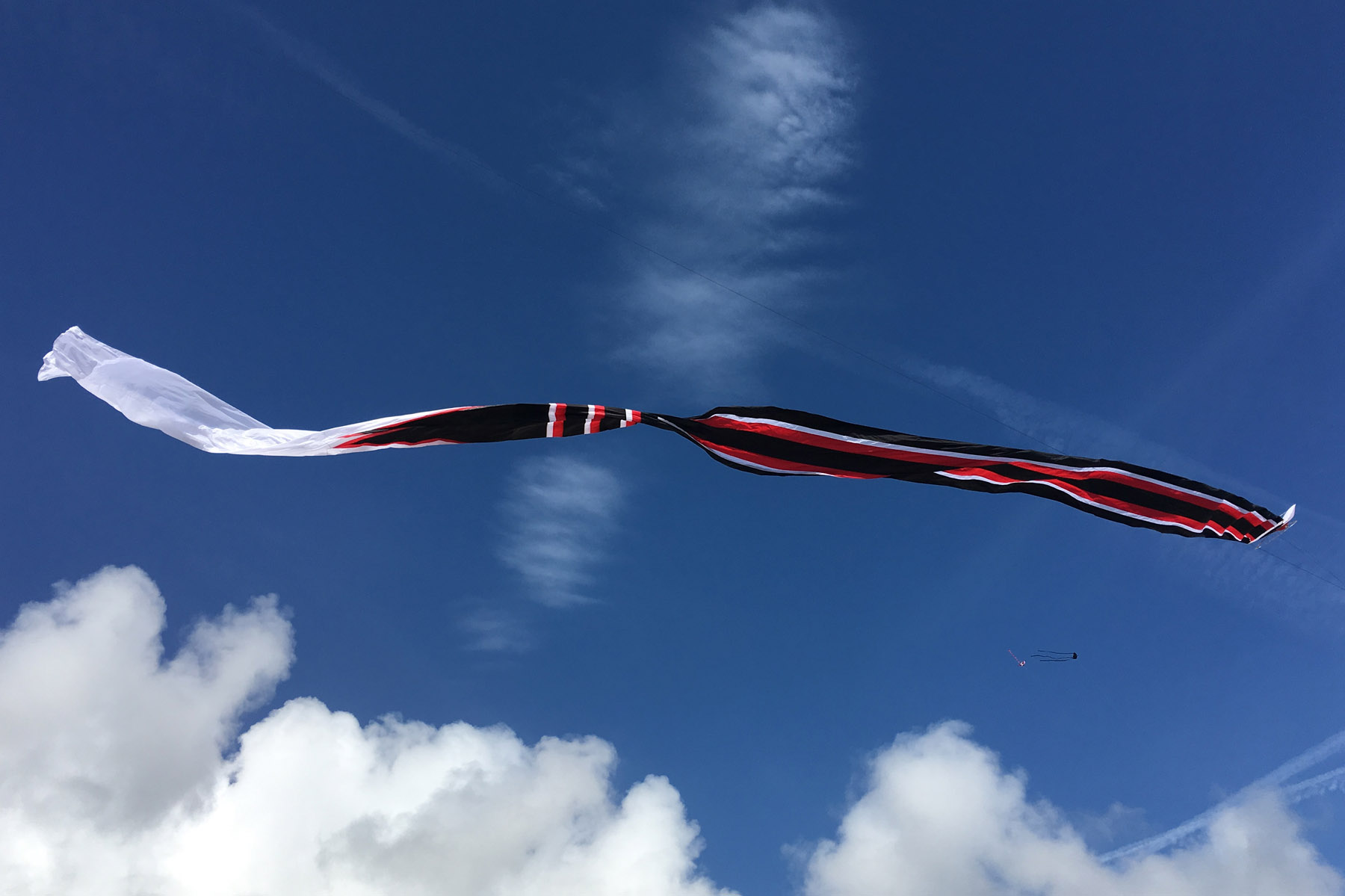
There are many, but if I had to choose one, it would be the experience of the Balinese Janggan kite. This kite evokes a wave of emotion in me, usually even bringing tears to my eyes every time I witness it rising into the sky. I’m not entirely sure why, but I learned from friends in Bali that watching a Janggan fly can put some people into a kind of trance. After all, it is the most sacred of the Balinese kites.
The first time I saw a Janggan being launched was in 2019 during the kite festival in Spotorno, Italy. The Bali Kite Team were guests of honour and brought all their traditional Balinese kites. When the Janggan went up, that wave of emotion hit—I had goosebumps and started to cry. I was also taking photos of it while it was flying. Later, when looking through those photos, I noticed a cloud above the Janggan that looked like a face. The spirit of the Janggan!
From that moment on, I dreamed of going to Bali to experience their kite culture firsthand. I finally managed to do so in the summer of 2025. For two full days, I watched traditional Balinese kite competitions, and it was the most wonderful thing I have seen so far in the kite world. The way kites are rooted in Balinese culture is incredible. Kite magic.
You have experience as a trainer, and workshops are a key part of your work. How do you organise them, and what do they mean to you?
Workshops are a very important part of my kite activity—perhaps even my favourite part. After spending a lot of time alone designing kites and preparing kits, the real reward comes when I finally get to spend a few days with inspiring people during the workshop itself.
So far, I have conducted workshops in the UK, Finland, the USA, and Italy. In the UK and Finland, they were organised by small kite clubs. They would select a model from my current offerings, and each participant would choose their own colour combination. Once I have all the information, I prepare the kits. Each kit contains pre-cut fabric, structural elements, a full-size template, and instructions. On the day, I arrive with the kits and the participants arrive with their sewing machines.
The workshops in the USA were organised similarly, but they were part of large conferences where many workshops led by kite experts took place simultaneously. The workshops in Italy, which take place during the Artevento festival, focus on the theme of each year's edition. In previous years, we made flamingos and poppies; this year, the theme combines the Canticle of the Sun by St. Francis of Assisi with the Japanese Suruga kite. My idea for these workshops is to create many kites of the same shape, each with a different image, yet all forming part of a larger whole.
I try to create a relaxed atmosphere where people aren't afraid to try something new, even if they have never sewn or built anything like this before. The greatest joy is when someone who has never built a kite before completes the workshop and flies their creation for the first time. Workshops are also a moment of sharing—not only technical knowledge but also passion. And the sharing is mutual; I often learn interesting tricks from the participants. I love how openly we share our little sewing and kite-making secrets.
What does it mean to you when a kite, or even an entire series, finally soars into the sky, displaying its beauty?
When a kite finally rises into the sky, it is always a very special moment for me. Until that point, it exists only on the ground—as an idea, a drawing, pieces of fabric, many hours of sewing, and small decisions. When it lifts into the air, everything suddenly comes together.
For me, it is a moment of relief, joy, and sometimes even a hint of surprise. You never know exactly how a kite will behave in the wind until you actually fly it. When it flies well and displays its colours and shapes against the sky, it feels like the project has truly come to life.
If it is a whole series of kites flying together, the feeling is even stronger. It is no longer just a single object; it becomes a kind of moving composition in the sky. Seeing something that started as an idea in my head become part of the landscape, interacting with the wind and the light, is always deeply rewarding. It reminds me why I make kites in the first place.
Is it meaningful to you that people feel joy and a sense of freedom through kites?
Yes, very much so. When a kite rises into the sky, something simple but powerful happens: people look up, they smile, and they slow down for a moment. It creates a space where you can forget everyday worries and just enjoy the wind, the colours, and the movement. I think kites have a unique ability to connect people with one another and with nature. Kites are not just objects—they are shared experiences.
I’m very curious to learn more about the two kites that will be available from Spiderkites this year. Can you tell us more about "Lotus" and "Dahlia"?
Both motifs, Dahlia and Lotus, were created during my experiments with geometric shapes in a graphic design programme. I enjoy exploring how simple geometric forms can overlap and interact, and I tried to compose them in a way that suggests the structure of flowers. It’s fascinating how repeating circles and arcs can suddenly transform into something that feels organic and alive.
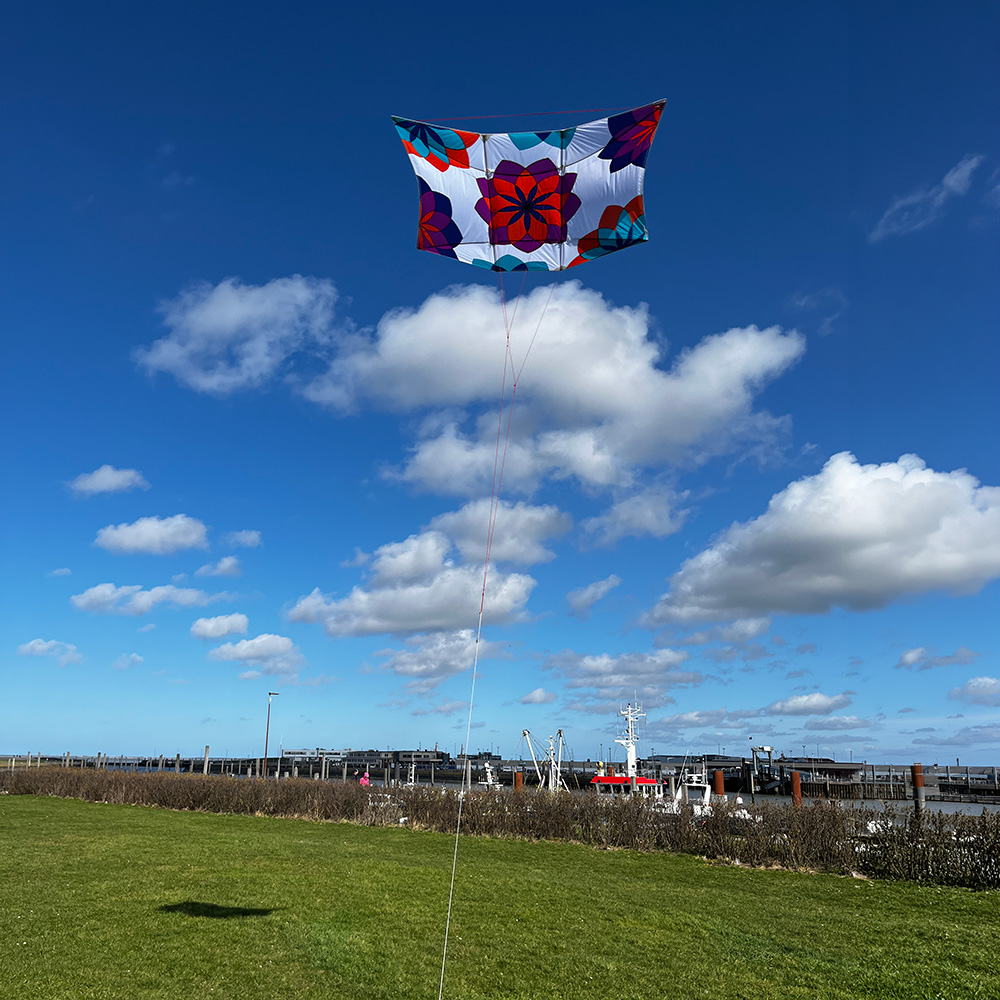
The Dahlia motif appeared first. Initially, it decorated several of my Della Porta kites in different colour combinations. I liked how the repeated petals formed a pattern that felt both structured and floral. Later, I used this pattern again when designing a postcard-type kite, where the geometry works particularly well on a flat rectangular surface.
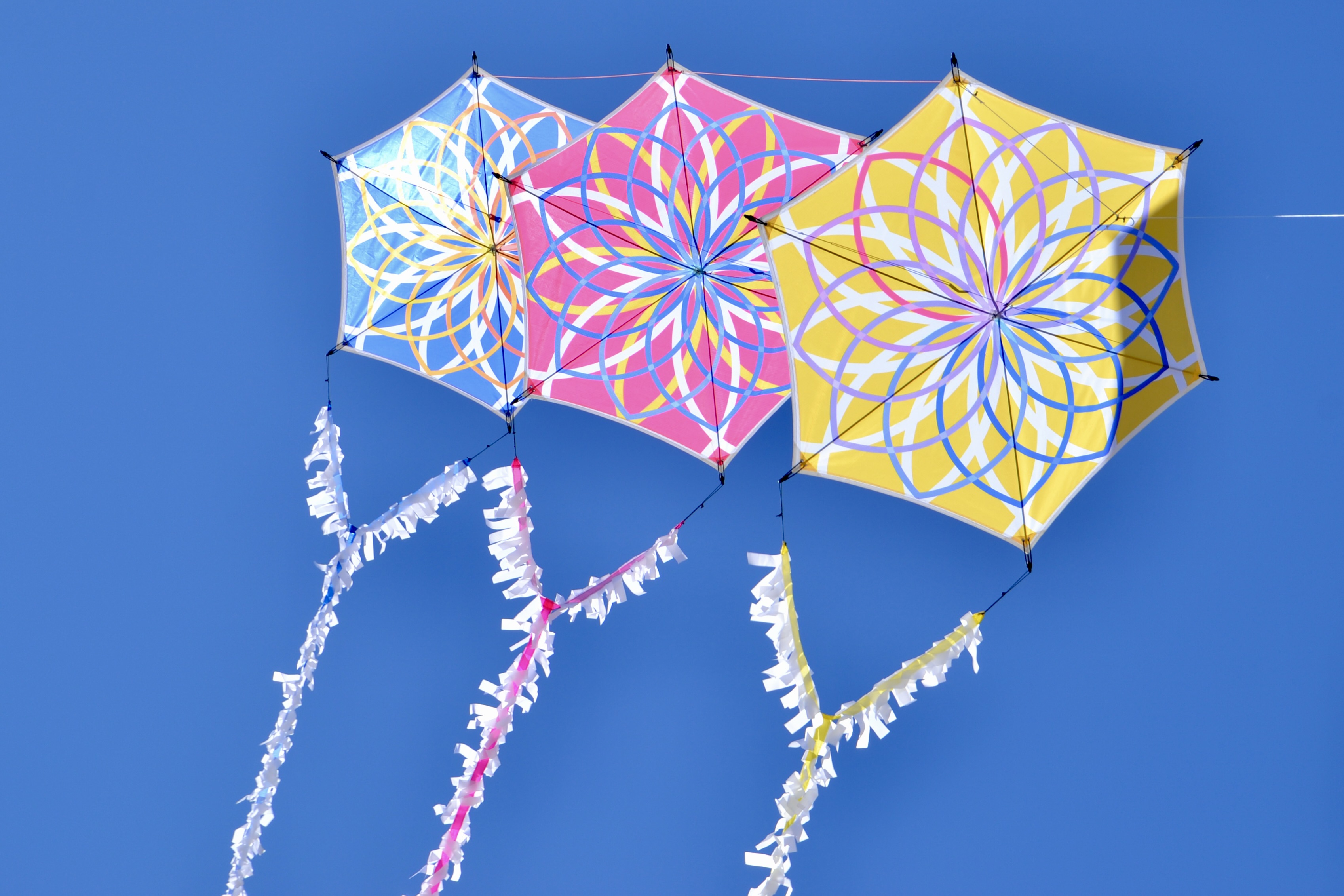
The Lotus design came a little later and developed in a different direction. I was interested in creating a pattern that felt more radial and meditative, with a strong centre and petals expanding outward. I liked how the overlapping lines created a sense of depth and a subtle three-dimensional effect in the sky. Because of its symmetry, it works beautifully on hexagonal shapes and gives the kite a very balanced appearance in flight.
I’m very happy that, thanks to the collaboration with Spiderkites, these designs will now reach many more kite flyers than would have been possible when I was sewing each kite myself. It’s exciting to imagine them appearing in different skies.
What are the unique features that characterise each design, especially in flight?
The Dahlia Postcard kite performs well in light to moderate winds. In a steady breeze, it feels almost "attached" to the wind, hanging calmly in the sky like a postcard pinned to a board. It’s a great kite to have with you when you discover the wind is lighter than expected. While other kites might struggle, the Dahlia often continues to fly beautifully.
The Lotus Hexagon is very reliable in moderate and even stronger winds. I especially enjoy playing with it when the wind is just slightly too weak for it to fly completely on its own. When it begins to descend, it starts to dance gently and the tail moves in soft waves. When the tail touches the ground, I pull the line to lift it back up again. I can spend a long time playing like this.
Do you prefer to fly the Lotus kites individually or in different colours as a train? Do you have tips for trimming a train of hexagons?
It depends on the space available. If there is plenty of room, I prefer to fly them separately, anchored in a harmonious arrangement so they form a kind of "lotus pond" in the sky. On the other hand, when connected in a train, they create a beautiful geometric structure stretching across the sky.
Each pair of kites is connected by three lines of equal length. A spacing of about 250 cm between kites is recommended, though 300 cm also works well. If the last kite in the train becomes a bit unstable, try shortening the middle connecting line between the last kite and the one before it by 1–2 cm. Even a small adjustment can help the train settle. The angle to the wind can be adjusted by moving the tow point on the bridle up or down. If the train starts to "dance," it may mean the wind is too strong or the angle of attack is slightly off—adjusting the tow point usually helps.
What do you associate with the lotus and the dahlia?
For me, the lotus flower is a symbol of tranquillity and beauty. Simply looking at this flower gives me a sense of pleasure and calm. I hope the Lotus kite evokes a similar feeling.
Dahlias represent diversity to me. Unlike many other flowers, dahlias have eight sets of chromosomes (humans have only two). This means there are countless hybridisation opportunities, resulting in incredibly diverse characteristics. I "hybridise" my dahlias in a graphic design programme! I have a vast number of colour combinations for dahlia kites sitting on my computer.
Is there anything else you’d like to share with our customers?
Don’t be afraid to experiment and play with your kites. You can adjust the bridle, the bow, fly them in various conditions, or combine them into sets. Once you start to "feel" the wind through your kite, the fun is even greater! For me, there is nothing better than lying on the sand or grass with my eyes closed, winder in hand, feeling the wind through the line.
_preview.jpg)
_preview.jpg)
_preview.jpg)